
READ BLOGS
From Idea to App: A Complete Guide to Custom Mobile App Development
Every app starts as a simple idea. A faster way to book appointments. An easier way for customers to reorder. A tool that saves your team an hour a day. The challenge is turning that idea into something people actually want to use.
That journey involves decisions about features, design, technology, security, testing and updates. The earlier they are made with care, the less you spend fixing them later.
That is why many businesses choose custom mobile app development services, which build the app around your users, workflows and goals.
Start With the Problem Your Mobile App Needs to Solve
Start by defining the problem the app should solve. Otherwise, features pile up without anyone asking whether they are needed.
Take an appointment booking app. It could include customer profiles, payments, reminders and booking management, but the core goal is still making appointments easier for customers and staff.
Many teams begin with a minimum viable product (MVP), a version with only the essential features. It reaches users sooner, and their feedback guides what comes next.
Understand What Your Users Actually Need From the App
Your users should shape the app. Even a feature-rich app fails if simple tasks feel difficult.
Identify what people will do most often. In a shopping app, that means finding products and checking out quickly.
User experience (UX) planning covers how easy and intuitive an app feels. A prototype, or clickable mock-up, lets you test each journey and spot confusing steps before major development begins.
Choose a Technology That Fits Your App Requirements
A framework’s popularity is not a good reason to choose it. Your app’s requirements are.
There are two main approaches. Native development means building a separate app for each platform in its own language, typically Swift for iOS and Kotlin for Android. Cross-platform development uses a single codebase for both, with frameworks such as Flutter or React Native.
Native apps offer the best performance and deepest access to device features such as the camera, GPS and Bluetooth, which suits something like a fitness app that syncs with a smartwatch. Cross-platform is usually faster and more cost-effective, making it a practical fit for booking platforms, customer portals or ordering apps.
Know When It Makes Sense to Hire Mobile App Developers
If your team has not built an app before, working with an experienced development team makes the technical side far easier to manage.
Developers handle areas that are easy to underestimate. These include architecture, the underlying structure of the app, and integrations, which connect it to systems you already use, such as a CRM or payment gateway. They also manage testing, performance and security.
When you hire mobile app developers, look beyond coding ability. Their understanding of your requirements, communication and approach to problems matter just as much.
Plan for Security and Future Updates From the Beginning
Launch is not the finish line. Apple and Google release major operating system updates every year, and users will request improvements.
Security needs attention throughout development. That includes authentication, which verifies users are who they say they are, often through two-factor login, along with permissions, data encryption and secure connections. A booking app storing customer contact and payment details needs these protections from day one.
A clean, well-organized structure also makes future updates far easier.
How Buildnetic Can Help Bring Your App Idea to Life
At Buildnetic, we build custom software around the specific needs of each business, including mobile applications. Every project starts with understanding your idea, your users and what the app needs to achieve.
We then shape the approach around your product, taking it through development and testing to launch, with room to improve as your business grows.
Frequently Asked Questions
What are custom mobile app development services?
They involve building an app around your specific business needs, users and workflows, rather than adapting a ready-made product.
How should I start a mobile app project?
Define the problem you want to solve, then identify your target users, essential features, platforms and expected business outcome.
Should I develop for Android and iOS?
It depends on your audience, budget and requirements. Cross-platform can cover both cost-effectively.
When should I hire mobile app developers?
Early in the project, when their input can shape technical planning, development, testing and security.
Can I add features after launching the app?
Yes. Most apps evolve through updates based on user feedback and business needs.


How Much Does It Cost to Build a Mobile App? A Realistic Breakdown
Ask three development firms what your app will cost and you can easily get three quotes that are miles apart. That’s not because someone is trying it on. It’s because “mobile app” covers everything from a six-screen booking tool to a marketplace with payments, live tracking and four different types of user login.
So before you set a budget, it helps to understand what actually sits behind the number. Not just the total, but which parts of your idea are driving it, because that’s what decides whether your budget survives contact with the real build.
Here’s the breakdown.
How Much Does It Cost to Build a Mobile App?
The range here is vast. On one end, you’ve got a lean MVP with a handful of screens and basic backend needs. On the other, a full enterprise product with payments, live tracking, several user roles, AI features, and a tangle of integrations. Naturally, the second one takes a lot more work.
One thing worth keeping in mind: adding more features doesn’t always bump up the price in a way you’d expect. Sometimes something that looks small on paper turns into a real headache, needing heavy backend work, security testing, and a handful of third-party services nobody planned for at the start.
Online payments are a good example. It’s never just “add a pay button.” Someone still has to build out the transaction flow, handle authentication, manage failed payments, lock down security, set up confirmations, and wire up all the backend logic behind it.
What Factors Affect Mobile App Development Cost?
Most of the cost really comes down to the usual suspects: how complex the app is, which platforms you’re building for, the UI/UX work involved, backend needs, integrations, testing, and where your dev team is based and how much experience they’ve got.
Platform choice matters more than people expect. Building native apps separately for iOS and Android usually takes more dev time and testing than a cross-platform build. That said, picking a framework just because it looks affordable on paper can become an expensive choice in the long run, if the app later needs something platform-specific that framework can’t handle well.
User roles are another thing to plan around early. An app serving customers, vendors, delivery staff, and admins all at once means separate workflows, permissions, dashboards, and test scenarios for each group, and that adds up quickly.
Which Features Increase App Development Costs?
Some features just cost more than others, plain and simple. Real-time location tracking, video calling, chat, subscriptions, payment gateways, advanced search, recommendation engines, AI capabilities, third-party API integrations, these are the ones that really drive up the effort and the price tag.
Security is worth calling out separately here. It shouldn’t be an afterthought bolted on near launch. Any app dealing with personal data, financial transactions, or sensitive business information needs stronger authentication, encryption, access controls, ongoing monitoring, and more thorough testing from the start.
Are There Hidden Costs After App Development?
Here’s something a lot of people underestimate: the money you spend building the app isn’t the whole story of owning it.
Even after launch, the costs don’t just stop there. You’re still paying for cloud hosting, database services, third-party API fees, app store fees, monitoring, security patches, bug fixes, analytics, and whatever comes out of real user feedback down the line. Maintenance tends to be the one that sneaks up on people though, since operating systems, devices, libraries, and outside services keep changing long after your app’s already out in the world.
Planning for these costs upfront just makes for a far more realistic picture of what you’re actually signing up for.
How Can You Reduce Mobile App Development Costs?
Chasing the developer who quoted the lowest price in the market, isn’t usually the smart move here. Controlling scope is.
Start by getting clear on the actual problem your app is solving, then figure out the bare minimum feature set needed for a first release. Anything beyond that can wait until real users tell you what they actually want.
Cross-platform development is another good lever, when it fits the product. It can cut down on duplicated work across iOS and Android, though whether it’s the right call still depends on your performance needs and any platform-specific features you can’t skip.
And when it’s time to hire mobile app developers, don’t just look at the hourly rate. Pay attention to whether they actually understand your product, how well they estimate scope, how clearly they communicate, and whether what they build can scale with you down the road.
Work Out Your Scope Before You Ask for Quotes
All of the above only becomes useful once you’ve written your own requirements down. Get your platforms, key features, user types, integrations, expected screen count and any special requirements on paper first.
With that in hand, you can compare development proposals properly. Instead of wondering why one quote is higher than another, you can point to exactly which part of the scope explains the gap.
That’s the real value of doing this work early. Not the number itself, but knowing your own scope well enough to spot when a quote has misread it, or when the feature you assumed was minor is the one driving the price.
If you’d like help putting that picture together, talk to the team at Buildnetic. We’ll go through your feature list, flag the parts that usually cost more than people expect, and give you a realistic range before you start collecting proposals. If the honest answer is that your first version should be smaller, we’ll tell you that too.
FAQs
How accurate are online app cost estimates?
They give you a realistic range rather than a fixed price. Estimates are most accurate when your requirements are already clear, and least accurate when your features are still vague. The final figure depends on your actual scope, the technical architecture, the integrations you need, and the design and testing the build calls for. Treat any early estimate as a planning number and expect a detailed proposal to move it in one direction or the other.
What is the biggest factor affecting app development cost?
Complexity, more often than not. Features tied to payments, real-time communication, location services, AI, multiple user roles, or custom backend systems tend to demand a lot more development work.
Should I build for iOS and Android at the same time?
Depends on your audience and budget. Cross-platform development works well when you want to reach both platforms without doubling the effort, while native development makes more sense when platform-specific performance or functionality really matters.
How can I get a more accurate app development estimate?
Put together a feature list, decide on your target platforms, describe your user types, and outline the integrations you’ll need. From there, a development team can turn that into a much more detailed scope and estimate.
iOS and Android App Development Company: What Should Businesses Check Before Signing a Contract?
Most app contracts get read once, quickly, by someone who is mainly looking at the price and the delivery date. That’s understandable. It’s also where a lot of expensive trouble starts.
Apps have a few problems, websites don’t. Two app stores with their own rules sit between you and your customers. Apple and Google both release big updates every year. And there’s a file called a signing key that, if you lose it, means you can never update your Android app again. Ever. You’d have to publish a new one and ask every user to download it from scratch.
None of that is in the standard contract template. So before you sign with any iOS and Android app development company, here’s what to look for and what to ask them to add.
Is the Platform Decision Written Down, Along With the Reasoning?
The contract should say what’s being built and how. One codebase serving both stores, or two separate apps built natively for iOS and Android.
Both approaches are fine. Cross-platform tools like Flutter and React Native usually cost less and get you to both stores faster, which is why most business apps are built that way now. Native builds make more sense when you need heavy graphics, tight performance or deep access to phone hardware. What matters is that somebody made an actual decision rather than defaulting to whatever the team already knows.
Ask them to explain the choice in plain terms. If you’re quoting several firms, some will propose cross-platform mobile app developers and others will push native, and the prices won’t be comparable until you understand why each one chose what they chose.
Who Owns the Store Accounts and the Signing Keys?
This is the one that causes real damage, and it’s usually missing from the contract entirely.
Your Apple Developer account and your Google Play Console account should be registered to your company, paid for on your card, with your developer added as a user. Not the other way round. If the app sits in their account, you can’t move it easily, and getting it transferred later depends entirely on their goodwill.
The same goes for the signing keys, along with any push notification certificates. These are the files that prove to Apple and Google that an update genuinely comes from you. Ask for them to be handed over, in writing, and store a copy somewhere your business controls. A developer who shrugs at this question hasn’t been burned yet, which isn’t reassuring.
What Exactly Counts as Finished?
“Delivery of the application” means very little on its own. Finished should mean the app is live in both stores and working, not that the code has been emailed to you.
Get acceptance criteria written down. A list of what the app must do, on which phones and which operating system versions, for you to sign it off. Include the devices your customers actually use. If a good chunk of your audience is on older, cheaper Android phones, put that in the document, because an app tested only on recent flagships will disappoint them.
Tie your final payment to that milestone rather than to a date. Dates slip for all sorts of reasons. Working software in the store is a much harder thing to argue about.
Who Deals with the App Stores, Including Rejections?
Which raises the next question, because getting into the stores isn’t guaranteed.
Apple reviews every app and every update, and rejections are routine. Common reasons include missing privacy details, sign-in requirements, payment rules and features the reviewer thinks are too thin. Google’s process is lighter but still catches plenty.
The contract should say who prepares and submits the store listing, who responds to reviewers, and importantly, who pays for the rework when a rejection means changing something. If that isn’t stated, you’ll be having the argument at the worst possible moment, with a launch date already promised to your customers.
What Happens When iOS and Android Update?
Every September or so, Apple ships a new version of iOS. Google does the same with Android. Things break. A login screen or a camera feature that worked fine last month stops working, and your reviews take the hit before anyone on your side notices.
Ask what happens then. Is there a warranty period where bugs get fixed free, and how long is it? Ninety days is common, but check whether an operating system update counts as a bug or as new chargeable work, because those are very different answers. Then ask what ongoing maintenance costs per month, and how quickly they respond when something breaks.
An app is not a one-off purchase. If nobody has mentioned ongoing costs by the time you’re reading the contract, that’s the question to ask before you sign it.
What Third-Party Code is in There, and Who Pays for It?
Modern apps are built partly from other people’s components. Analytics, crash reporting, maps, payments, chat, push notifications. Most are fine. Some carry licence conditions, and some carry monthly fees that grow with your user numbers.
Ask for a list of every third-party service the app will depend on, what it costs, and whose account it sits in. Accounts in your name, with your card. You want to know now if your app quietly depends on a service that charges more once you pass ten thousand users.
Who Handles Privacy, Permissions and the Store Forms?
Both stores make you declare what data your app collects. Apple calls them privacy labels, Google calls it the data safety form. Get them wrong and you get rejected, or worse, you end up making a public statement about your data handling that isn’t accurate.
Depending on where your customers are, you may also have obligations under GDPR in Europe or India’s data protection rules. The contract should say who drafts the privacy policy, who completes the store declarations, and who is responsible if the app collects something it shouldn’t. Most developers will help with the forms. Very few will take legal responsibility for them, and you should know which you’re getting.
What Happens if it All Goes Wrong?
Finally, the part nobody enjoys discussing in a first meeting.
Link payments to milestones rather than the calendar, so you’re never far ahead of the work. Make sure the contract says the source code, the design files and the documentation become yours once paid for, and that the code lives in a repository owned by your business throughout, not just at the end. Check the notice period, and check what a handover actually involves if you part ways halfway through.
A good iOS and Android app development company won’t flinch at any of this. They’ve been on the wrong end of a messy handover too and would rather it was written down.
Two Things to Sort Before You Sign
Ask where the app store accounts will be registered, and ask what happens when iOS and Android release their next big update. Those two answers will tell you more about how a firm works than the rest of the proposal combined.
If you want someone to look over a contract or a proposal before you commit, get in touch with our team. We’re happy to point out what’s missing, even if you end up going with someone else.
FAQs
What should be included in a mobile app development contract?
At minimum: what’s being built and on which platforms, acceptance criteria including test devices and operating system versions, who owns the code and design files, who holds the store accounts and signing keys, payment tied to milestones, a warranty period for bugs, ongoing maintenance terms, and what happens if either side wants to end the agreement.
Who owns the app and the source code?
Whoever the contract says owns it. Many templates leave ownership with the developer by default, and in some countries that’s the legal starting point unless the agreement says otherwise. Make sure yours clearly transfers all rights to your business on final payment, including design files and any custom artwork.
Should we build native or use cross-platform mobile app developers?
Cross-platform suits most business apps. One codebase covers both stores, which usually means lower cost and a faster launch. Native is the better choice for games, apps that lean heavily on the camera or sensors, or anything where performance is the product. Ask any firm to justify their recommendation against your specific requirements rather than in general.
Who should own the Apple and Google developer accounts?
Your business, always. Register both accounts in the company name, pay with a company card, and add your developer as a user with the access they need. Moving an app out of someone else’s account later is possible but slow, and it depends on their cooperation at a point when you may not have much.
What happens if the app gets rejected by the App Store?
Rejections are normal and usually fixable within a few days. The thing to settle in advance is who handles the response and who pays for any changes. If the rejection is down to how the app was built, it should sit with the developer. If it’s down to your business model or your content, it will sit with you. Write that split into the contract rather than assuming it.
Before You Hire Web Developers: 9 Questions That Can Save Your Business From a Costly Build
Most expensive software projects don’t fail because the developers were bad. They fail because nobody asked a few awkward questions at the start, when changing course was still an affordable choice.
You’ve probably seen a version of it. The “simple” website that needed a booking system halfway through. The app that worked perfectly on the founder’s iPhone and crashed on every Android phone in the office. The agency that went quiet the week after the final invoice, taking the only copy of the code with them.
None of that is bad luck. Every one of those problems could have been caught with a question asked before anyone wrote a line of code. So before you hire web developers, here are the nine worth asking, starting with the ones you need to ask yourself.
1. What Problem is this Actually Solving?
“We need a new website” isn’t a problem. It’s a solution someone has already picked.
Try to write the real problem in one plain sentence. “Customers keep calling to check order status because they can’t see it online.” “Our sales team spends two hours a day copying leads between spreadsheets.” If you can write that sentence, you’ve got a project. If you can’t, you’ve got a wish list, and wish lists turn into long, expensive builds that never quite feel finished.
That one sentence also becomes your filter for every feature request later on. Does this help solve the problem? No? Then it can wait.
2. Do You Need Something Custom at All?
Once you know the problem, check whether someone has already solved it.
A lot of businesses pay for custom builds when Shopify, WordPress or a decent off-the-shelf tool would do 90% of the job for a fraction of the cost. Custom makes sense when your process is genuinely different from everyone else’s, when you need to connect systems that don’t normally talk to each other, or when the software itself is what you sell.
The same goes for apps. Custom mobile app development services are worth paying for when people will use the thing often, need it to work offline, or need phone features like the camera, GPS or notifications. If customers will open it twice a year to check the price, a mobile-friendly website will do the job and save you a lot of money.
A good developer will tell you this. If the first person you talk to jumps straight to a full custom build without asking about alternatives, that tells you something.
3. Who Writes the Spec, and What Happens When it’s Wrong?
The next question is how the work gets defined.
Someone has to write down what’s being built. Screens, features, what happens when a user clicks each button. If you write it, gaps you didn’t think of become your problem. If the developer writes it, check it properly before signing, because whatever’s in that document is what you’ll get.
And the spec will be wrong somewhere. It always is. So ask how changes are handled. On a fixed-price deal, every change becomes a new quote, which is fine until you’re on your twelfth one. On a time-and-materials deal, changes are easy but the budget can drift. Neither is wrong. You just need to know which one you’re signing up for and how change requests get priced.
4. Who Will Actually Be Doing the Work?
Here’s something that happens all the time. You meet a sharp, senior developer in the sales meeting. Then the project starts and you never see them again, because the actual work has gone to someone with eight months’ experience.
Ask straight out: who will write the code, and can I speak to them before we sign? Ask how long they’ve been with the company, and whether they’ll stay on your project until it’s done or get moved elsewhere halfway through. Team changes mid-build cost weeks, because the new person has to learn everything the old person knew.
5. Who Owns the Code, and Where Does it Live?
This one gets missed more than any other, and it’s the most painful to fix later.
The code should sit in a repository that you own, like a GitHub or GitLab account in your company’s name, with the developer given access. Not in their account with you given access. Same with hosting, domain names, app store accounts and any paid services the project runs on. All of it should be in your name, with your login.
Check the contract says you own the code once it’s paid for. Plenty of small agencies keep ownership by default, not because they’re dodgy, but because nobody changed the template. You don’t want to find that out on the day you try to move to someone else.
6. How Will You Know It’s Going Well Before It’s Finished?
Once the build starts, the biggest risk is silence. Three months of “it’s coming along” and then a big reveal that isn’t what you pictured.
Ask how often you’ll see working software. Not screenshots or progress reports. Something you can click on. Every two weeks is a sensible rhythm. You should also get a test link, usually called a staging site, where you can try things out yourself whenever you want.
Seeing it early means spotting problems early, when they cost an afternoon to fix instead of a month.
7. Who’s Testing it, and On What?
Related to that: who checks it actually works?
Developers test their own code, but they test it the way they built it, which means they miss the things real people do. Ask whether there’s a separate tester, and what devices and browsers they check on. If most of your customers use cheaper Android phones, it doesn’t matter how good the app looks on a new iPhone.
Get a handful of real users to try it before launch too. Watching someone who’s never seen the thing try to use it will show you more problems in ten minutes than a month of internal review.
8. What Happens After Launch?
Launch day feels like the finish line. It’s closer to the start.
Every website and app needs looking after. Security updates, bug fixes, hosting, and for apps, keeping up with new versions of iOS and Android. Apple and Google release updates every year, and those updates break things. A login screen that worked fine in September can stop working in October with no warning.
Ask what support looks like after the launch. Is there a warranty period for bugs? What does ongoing maintenance cost per month? How fast will they respond if the site goes down on a Saturday? A common rule of thumb is to budget somewhere around 15 to 20% of the original build cost every year for upkeep. If nobody mentions ongoing costs at all, ask why.
9. What Will This Really Cost?
Which brings us to the number that matters.
The developer’s quote isn’t the full cost of the project. You’ll also need to pay for design if it’s not included, content and photos, third-party tools and integrations, hosting, app store fees, testing, and the ongoing maintenance from the last question. Then there’s your own team’s time, which almost nobody counts. Someone on your side will spend hours every week answering questions, checking work and making decisions.
Add all of that up before you commit. If the real total makes you nervous, it’s much better to know now, when you can still cut features, than halfway through when you can’t.
Before You Sign Anything
If you only take one thing from this, make it the first question. Write down the problem in one sentence. Most of the other eight get easier once that’s clear, and a surprising number of projects get smaller, cheaper or cancelled altogether at that stage. That’s a good outcome, not a bad one.
If you’d like a second pair of eyes before you commit, talk to our team. We’ll go through what you’re planning and tell you honestly if an off-the-shelf tool would do the job instead. If it does need building, you can see how we approach web development and mobile app development projects.
FAQs
How much does it cost to hire web developers for a business project?
It depends mostly on what you’re building, not who builds it. A standard business website on WordPress or Shopify is a very different job from a custom web app with logins, payments and integrations. Most developers charge either a fixed project fee or an hourly or monthly rate. Get at least three quotes for the same written spec so you’re comparing like with like.
Should I hire a freelancer, an agency, or dedicated developers?
A freelancer suits small, well-defined jobs with a clear finish line. An agency suits projects that need design, development and testing together, managed for you. Dedicated developers, where you hire people who work only on your project, suit longer builds where you want control over priorities without the cost of hiring staff directly.
How long does it take to build a custom website or app?
A straightforward business website usually takes a few weeks. A custom web application or mobile app typically takes three to six months for a first version, depending on how many features it has and how quickly decisions get made on your side. Slow feedback from the client is one of the most common reasons projects run late.
Do I need a mobile app or will a mobile-friendly website do?
A mobile-friendly website is enough for most businesses. Custom mobile app development services make sense when customers will use it often, need it to work offline, or need phone features like notifications, the camera or location. If people will only use it occasionally, a website is cheaper to build, cheaper to maintain and easier for people to find.
Who owns the code when I hire an outside developer?
Only whoever the contract says owns it. Many templates leave ownership with the developer by default. Make sure the agreement clearly transfers the code to you once it’s paid for, and that the code, hosting and domain all sit in accounts registered to your business.
Ecommerce Website Development Agency: What Separates High-Converting Online Stores From Average Ones?
Plenty of online stores look the part. Nice banners, a huge catalogue, three or four payment options at checkout. And yet sales barely trickle in. Why? Because looks were never the real problem. What separates a high-converting store from an average one comes down to three simple questions: can shoppers find what they want, do they trust you enough to enter their card details, and will they come back next month?
That’s the gap a good ecommerce website development agency is supposed to close. Not by making a store prettier, but by getting the fundamentals right: speed, usability, the functionality behind the scenes, security, and a build that’s shaped around what the business actually needs to achieve. Here’s what that looks like in practice.
Easy Buying Is What Sets Top Stores Apart
An ecommerce website converts better when buying feels effortless. Most of the time, that just means not getting in the customer’s way. Nobody enjoys hunting through a confusing menu, waiting on a page that takes forever to load, or running into a surprise extra step right before they hit “Pay now.”
Average stores make shoppers work for it. High-converting ones do the opposite. Categories that make sense, filters that actually filter, a search bar that returns something useful, product info you can trust, photos that show the product properly, and an “Add to cart” button that’s obvious rather than buried. Put those together and browsing turns into buying without the customer even noticing the shift.
Why Do Faster Online Stores Sell More?
Speed shapes how someone feels about a business before they’ve read a single line of copy.
A product page that drags loses people before they see what’s on offer. A slow checkout is worse, because that’s usually the exact moment someone had already decided to buy. Now they’re gone, cards still in their pocket.
Fast stores don’t get that way by accident. They’re built on optimised images, clean code, hosting that can keep up, caching, and an architecture planned from day one. Performance is part of the build, not something bolted on after launch once the drop-off numbers start looking bad.
Mobile Experience Can Make or Break Sales
Most people shop on their phones now, and that’s where plenty of average stores fall apart. Buttons, menus, image galleries, forms, all of it needs to work properly on a small screen, not just “look okay” in a desktop mockup someone approved months ago.
High-converting stores are designed with thumbs in mind. Tap targets that are easy to hit, product images you can swipe through, and checkout forms that don’t feel like filling in a tax return.
Trust Signals That Turn Visitors Into Buyers
Trust is often the last hurdle before a sale, and average stores tend to overlook it. If a shopper has any doubt about who you are, what they’re getting, or what happens if something goes wrong, they won’t hand over their payment details.
Well-built stores answer those doubts before they come up. Genuine customer reviews, clear shipping costs and delivery times, an easy-to-find returns policy, recognisable payment options, an SSL certificate, and real contact details all help. None of it is flashy, but it’s often what turns “maybe later” into “buy now.”
What Does a High-Converting Checkout Look Like?
Checkout is where average stores lose the most money. Forced account creation, long forms, shipping costs that only appear on the final screen, limited payment methods. Every one of these gives shoppers a reason to leave.
A high-converting checkout keeps things short and predictable. Guest checkout, autofill, a progress indicator, total costs shown upfront, and the payment options people actually use, from cards to digital wallets. The fewer surprises, the more orders actually go through.
Good UX Is the Difference You Don’t Notice
Good UX tends to be invisible. You don’t notice it, you just don’t get annoyed. That’s kind of the whole point.
A visitor should always know where they are, what to do next, and how to go back if they took a wrong turn. Product comparisons, wishlists, an account area, and personalized recommendations can genuinely help, but only if they solve a real problem rather than being added because a competitor has them.
Average stores pack in every feature they can. High-converting ones pick the handful that actually matter to the person shopping.
Bringing Customers Back After the First Sale
Getting the first sale is only half the job. The stores that grow steadily are the ones people return to.
That comes down to the experience after the order. Clear confirmation emails, easy order tracking, simple reorders, saved addresses and preferences, and follow-ups that feel useful rather than spammy. Loyalty rewards and personalized offers help too, as long as they’re based on what the customer actually bought.
Web Applications Give Growing Stores an Edge
For a lot of growing businesses, a basic storefront isn’t enough anymore. Some need customer portals. Others need inventory dashboards, vendor management tools, subscription billing, booking systems, recommendation engines, or a proper connection to their CRM and ERP.
This is where web application development solutions come in. They stretch an ecommerce platform beyond a shopping cart and connect it to how the business actually runs. Stock stays accurate, orders move faster, and customers get a smoother experience, which is exactly the kind of edge average stores don’t have.
Buildnetic works this way on purpose, pairing ecommerce development with custom application builds across a wide tech stack, so businesses get a platform shaped around their needs rather than squeezed into a generic template.
Why Does Scalability Matter After Launch?
A store that runs fine with fifty products can behave very differently once traffic, orders, and integrations start piling up. That’s usually where the cracks show.
Scalable architecture lets a business grow without rebuilding the platform every time demand jumps. Cloud infrastructure, modular development, databases that hold up under load, proper testing, and ongoing monitoring keep things stable as everything else gets more complex.
The best ecommerce project isn’t the one that launches smoothly. It’s the one still performing two years later, when the business looks nothing like it did on day one.
Choosing the Right Ecommerce Development Partner
Don’t judge an agency purely on a portfolio full of nice screenshots. Ask how they approach conversion, speed, security, integrations, testing, and support after launch, because launch day is really just the start.
It’s also worth asking how they handle changing requirements. New payment methods appear, sales channels expand, product lines shift, and customer expectations move faster than most roadmaps. The right partner grows with all of that instead of locking you into an architecture that becomes a maintenance headache a year or two later.
The Difference Is in the Details
High-converting stores aren’t built on better banners or bigger catalogues. They win on the things shoppers barely notice: pages that load fast, checkouts that don’t frustrate, trust signals in the right places, and systems that keep working as the business grows. Average stores get some of these right. The best ones get all of them right.
If you’re planning a new online store or wondering why your current one isn’t converting, Buildnetic can help you find what’s holding it back and build something that sells. Let’s talk.
FAQs
- What does an ecommerce website development agency do?
An ecommerce website development agency designs and builds online stores, covering everything from the storefront and product catalogue to the cart, checkout, payment integrations, security, and performance. Most also provide maintenance and support after launch.
- What makes an online store high-converting?
A high-converting online store makes it easy to find products, trust the business, and complete a purchase. Fast load times, mobile-friendly design, clear product information, genuine reviews, and a short, simple checkout are the biggest factors.
- How can an ecommerce website increase conversions?
Start by removing friction. Speed up slow pages, simplify navigation, offer guest checkout, show total costs early, and add trust signals like reviews and a clear returns policy. Analytics and heatmap tools can show exactly where shoppers drop off.
- Are custom ecommerce solutions better than templates?
It depends on the business. Templates work well for simple stores with standard needs. Custom development makes more sense when a business needs unique workflows, deeper integrations, advanced features, or more control over how the platform scales.
- Why are web applications useful for ecommerce?
Web applications connect the customer-facing store to the systems running behind it, such as inventory, CRM, order management, subscriptions, and analytics. This keeps data in sync, reduces manual work, and gives customers a smoother experience.
- What should I ask an ecommerce development company?
Ask to see live stores they’ve built, not just their case studies, and find out what technology they use and why. It’s also worth asking how they handle security, testing, integrations, scaling, and post-launch support, and how they measure whether a store is actually succeeding.
Custom Website Development Company: 8 Features Your Business Website Should Not Compromise On
Here’s the thing about business websites: looking aesthetic is honestly the easy part. What’s harder is building something that actually helps people, they land on your page, find what they came for, feel like they can trust you, and then reach out to your team. And if the site’s slow or confusing, none of that happens. Doesn’t matter how good your offer is.
That’s really why so many businesses end up going with a custom website development company instead of a template. It gives you room to build the site around how your customers actually behave, not the other way round. But custom doesn’t automatically mean good. You still need the fundamentals in place. So let’s get into what those actually are.
Mobile-Friendly Design Across Every Screen
Think about how you browse the internet yourself. Probably on your phone half the time, right? Your customers are no different. Someone might check you out on their phone during a commute and then pull the site up again later on a laptop, and both times it needs to just work.
This is where good responsive web design services earn their keep. It’s not about squishing a desktop layout until it fits a smaller screen, that’s the lazy version. It’s making sure buttons are actually tappable, forms don’t turn into a nightmare on a 6-inch screen, and images don’t take forever to load on mobile data.
Fast Page Loading
People are impatient. A few extra seconds of loading and they’re gone, and you never even get the chance to make your case. Speed isn’t just about that first impression either, it affects how smoothly someone can click around once they’re already on the site.
The biggest gains usually come from a handful of fixes: compressing images, minifying CSS and JavaScript, setting up browser and server caching, and choosing a host that doesn’t cut corners on server resources. And here’s a tip a lot of businesses miss, don’t just test speed on the office Wi-Fi. Try it on an actual mobile connection, maybe even a slow one, because that’s closer to what a lot of your visitors are dealing with.
Simple and Useful Navigation
Nobody’s going digging through six different pages just to find your contact number. If they can’t find it in a few seconds, a good chunk of them will just leave.
Keep your menu labels boring and obvious, services, about, contact, resources. Save the clever wordplay for somewhere else. It also happens to help search engines understand how your pages fit together, so there’s a nice side benefit there too.
Security Built into the Website
You really don’t want to be thinking about security after something’s already gone wrong. It needs to be implemented from the start,such as, protection against outdated plugins, weak logins, malicious scripts, the usual stuff hackers go after.
SSL certificates, secure forms, regular software updates, backups that actually work, access controls, some kind of monitoring in place, none of this is optional anymore. And if you’re handling anyone’s payment details or personal information, the bar needs to go up even further.
SEO-Ready Technical Structure
An aesthetic website can still be completely invisible on Google if the technical side is full of gaps. Search engines need to be able to crawl your pages and actually make sense of them.
That means clean URLs, a logical heading structure, good internal links, an XML sitemap, proper metadata, canonical tags sorted out, all of it. Get this right while you’re building the site, not six months later when you’re paying someone to sort it out.
Clear Conversion Opportunities
Not everyone who shows interest is ready to make a purchase immediately. Some just want a quote. Some want more information. Some are still deciding if you’re even the right fit.
Give people an easy next step at every stage, whether that’s a quick enquiry, a pricing request, or a call. The trick is knowing when to ask. Pop up too often and it starts to feel pushy, so let your calls to action show up where they actually make sense.”
Easy Content Management
Businesses change. Services get added, old ones get dropped, prices shift, and someone needs to be able to update the site without calling a developer every single time.
A decent CMS lets your team handle the small stuff themselves. Before picking one though, it’s worth thinking about who’s actually going to be logging in and making changes, and how much the site is likely to grow over the next year or two.
Analytics and Future Scalability
Your site should be telling you what’s really happening, not what you’re guessing is happening. Which pages people spend time on, where they bail, what actually leads to an inquiry, all of that’s sitting in your analytics if you’re paying attention.
That data should be shaping your decisions, not just sitting there unused. And the site itself needs enough flexibility to grow with you, new services, new pages, new integrations, whatever comes next.
Good choice. Here’s the full conclusion under that heading, with the first paragraph tweaked slightly so it echoes “basics”:
Get the Basics Right, and the Rest Follows
A good business website isn’t built on design alone. The real work happens behind the scenes: fast-loading pages, clear menus, solid security, and a structure Google can actually read. Get those right and everything else, from design to conversions, has something solid to stand on.
So when you’re talking to a custom website development company, look past the portfolio. Ask how they handle mobile performance, security, SEO and analytics, and what support looks like after launch. A website isn’t finished the day it goes live. It needs looking after as your business grows.
That’s how Buildnetic approaches every project. We start by understanding your business and your customers, then build a site that fits them, not a one-size-fits-all package. If you’re planning a new website or rethinking the one you have, let’s talk.”
FAQs
- Why is custom website development useful for businesses?
A custom website is built around how your business works and how your customers behave. That means better performance, tighter security, and room to add new features as you grow, without being boxed in by a template. - What makes a website responsive?
A responsive website uses flexible layouts, scalable images, and CSS media queries to adjust automatically to any screen size, whether that’s a phone, tablet, or desktop. The content stays easy to read, buttons stay easy to tap, and menus adapt so visitors don’t have to pinch, zoom, or scroll sideways. - Should SEO be considered during development?
Yes, SEO should be part of the build from day one. Things like URL structure, heading hierarchy, internal linking, page speed, and XML sitemaps are much easier to get right during development than to fix after launch, when changes can mean redirects, lost rankings, and extra cost. - How can businesses improve website performance?
Start by running your site through tools like Google PageSpeed Insights to see how it scores on Core Web Vitals. From there, the usual fixes are compressing images, removing unused code and scripts, enabling caching, using a CDN, and choosing reliable hosting. Performance changes as you add content, so it’s worth checking regularly. - How often should a business website be reviewed?
A quick check on speed, security updates, and backups should happen monthly, with a deeper review of content, SEO, and analytics every quarter. A full audit once a year helps you spot bigger issues and decide whether the site still fits where your business is heading.
-
 22 May 2025The Future of Angular App Development: Trends to Watch in 2024
-
 30 Jul 2025Why Hiring Dedicated Developers is Smarter Than Outsourcing in 2025
-
 22 May 2025Hire Dedicated Laravel Developers: A Comprehensive Guide
-
 22 May 2025Fortress of Security: Top Cyber Security Services in the UK
-
 10 Nov 2025Unlocking Java: Revolutionizing Business Agility in 2025
How Much Does It Cost to Build a Mobile App in 2026? A Practical Cost Breakdown
Most people planning an app want to know the cost before anything else. However, the answer to it depends almost entirely on what the app needs to do. Two apps that look alike can end up with very different budgets once you factor in features, backend work and platforms. A mobile app development cost calculator gives you a rough starting figure, and this guide explains what sits behind it.
Typical App Development Costs in 2026
Globally, a simple app tends to start at around $8,000, and complex products often cost more than $100,000. Rates in India are lower, and with an Indian development team you can expect something close to this:
- Simple MVP: ₹4–10 lakh
- Medium-complexity app: ₹10–30 lakh
- Complex application: ₹30 lakh–₹1 crore
- Enterprise platform: ₹1 crore and above
Treat these as planning ranges rather than fixed prices.
What Drives the Cost Up?
Complexity has the biggest effect. A five-screen restaurant menu app needs little more than content and navigation. A food delivery app has to track riders in real time, take payments and give customers, restaurants and riders their own versions of the app.
Features add up quickly. Logins, notifications, maps and chat each take time to build and test, and anything that updates in real time needs a more capable backend. AI features also bring ongoing API charges and extra security work.
How Much Should You Set Aside for Design?
Design is often underestimated. Before any screens are drawn, a designer works out how people will move through the app, then turns that into wireframes and a clickable prototype you can try out.
The more user roles your app has, the more design work it needs. A booking app used by customers, service providers and an admin team is really three journeys to plan. Getting this right early costs less than reworking the app after launch.
Should You Build for Android or iOS First?
Launching on one platform keeps the first version smaller and more affordable. Which one depends on who your users are. Android dominates the Indian smartphone market, so apps aimed at Indian consumers usually start there. But iOS users spend more per head, so subscription and purchase apps often start there instead. What you want to avoid is splitting a tight budget across both.
Is Cross-Platform Development Inexpensive?
It often is. With Flutter or React Native, one codebase runs on both iOS and Android, so your team isn’t building the same features twice. Buildnetic develops with both frameworks.
Native development still makes sense for some projects, particularly apps that need high performance or rely on device hardware like AR or advanced camera functions.
What’s Included in Custom App Development?
A full project normally runs from planning and design through development, backend and database work, testing and launch, with maintenance afterwards. How much of each you need depends on the product. An appointment booking app can get by with a light backend, while a marketplace needs payments, vendor accounts and admin dashboards.
Buildnetic offers custom mobile app development for iOS, Android and cross-platform projects.
Keeping Costs Under Control
Start small. An MVP that does one job well will teach you more about your users than a feature-packed first release, and you can add the rest once you know what people actually use.
Before you sign up for custom mobile app development services, get the scope in writing, including platforms, integrations, user roles and post-launch support. It also makes quotes far easier to compare, since everyone is pricing the same thing.
Costs That Continue After Launch
Once the app is live, you’ll still be paying for hosting, third-party services, monitoring, security updates and new features. There are store fees too. Apple charges $99 a year for its Developer Program, and Google Play has a one-time $25 registration fee. It’s worth keeping these separate from the build cost in your contract.
FAQs
How accurate is a mobile app development cost calculator?
Accurate enough for early planning. The more detail you put in, the closer the estimate gets, though a proper discovery session is what gives you a figure you can budget against.
How much does an MVP cost in 2026?
With an Indian team, most simple MVPs cost between ₹4 and 10 lakh.
Does maintenance cost extra?
Yes. Many businesses budget around 15–20% of the original development cost each year for bug fixes, updates and hosting.
How long does it take to build an app?
Simple apps usually take 2 to 4 months. Larger products with custom backends can take six months or more.
Fortress of Security: Top Cyber Security Services in the UK
In today’s digital landscape, the need for robust Cyber Security Services in the UK has never been more critical. As businesses and individuals increasingly rely on technology for their daily operations and personal lives, the threat landscape continues to evolve and expand. This article explores the importance of cyber security and highlights some of the top services available in the UK to protect against digital threats.
The rising tide of cyber threats has made Cyber Security Services in the UK an essential component of any organization’s IT strategy. From small businesses to large corporations, and educational institutions to government agencies, no entity is immune to the risks posed by cybercriminals. The UK’s National Cyber Security Centre (NCSC) reports a steady increase in cyber attacks year over year, emphasizing the need for comprehensive security measures.
Key Cyber Security Services in the UK include:
- Threat Intelligence and Monitoring –
Proactive services that identify and track potential threats before they can cause harm. - Penetration Testing –
Simulated attacks to identify vulnerabilities in an organization’s digital infrastructure. - Incident Response and Management –
Rapid response teams that can quickly address and mitigate security breaches. - Security Awareness Training –
Educational programs to help employees recognize and avoid potential cyber threats. - Cloud Security –
Specialized services to protect data and applications hosted in cloud environments. - Network Security –
Comprehensive protection for an organization’s digital networks, including firewalls and intrusion detection systems. - Data Protection and Privacy Services –
Ensuring compliance with data protection regulations like GDPR. - Managed Security Services –
Outsourced security operations that provide 24/7 monitoring and protection.
The UK’s cyber security industry is known for its innovation and expertise, with many providers offering cutting-edge technologies such as AI-driven threat detection and blockchain-based security solutions. As cyber threats become more sophisticated, Cyber Security Services in the UK are evolving to meet these challenges head-on.
When selecting a Cyber Security Service in the UK, organizations should consider factors such as the provider’s track record, range of services offered, industry-specific expertise, and ability to scale with the organization’s needs. It’s also crucial to choose a provider that stays abreast of the latest threats and regulatory requirements.
Investing in robust Cyber Security Services in the UK is not just about protecting against immediate threats; it’s about building a resilient digital infrastructure that can support long-term growth and innovation. As the digital landscape continues to evolve, the role of cyber security in safeguarding the UK’s digital future cannot be overstated.
Buildnetic’s Cyber Security Experts!
At Buildnetic, we understand the critical importance of robust cyber security in today’s digital landscape. As a leading provider of Cyber Security Services in the UK, we offer comprehensive solutions designed to protect your organization from the ever-evolving threat landscape.
Our approach to cyber security goes beyond traditional methods. We leverage cutting-edge technologies and human expertise to provide a multi-layered defence strategy. Our advanced tools detect and eliminate 99.98% of threats automatically, allowing our skilled analysts to focus on hunting down the most sophisticated attackers that can only be identified and stopped by human intelligence.
We pride ourselves on our proactive approach to cyber security. Our team doesn’t just react to threats; we anticipate them. We conduct thorough investigations to identify the root causes of security incidents, enabling us to take preventive measures and provide recommendations that significantly reduce the risk to your business. This approach leads to fewer incidents, resulting in less disruption for your IT and security teams, employees, and clients.
Our suite of Cyber Security Services in the UK includes:
- Network Surveillance –
We offer 24/7 network monitoring to ensure your systems are always protected, helping you stay ahead of potential outages and manage network expansions effectively. - Updating and Patching –
We ensure your systems are always up-to-date with the latest security patches, protecting you from vulnerabilities that could lead to devastating attacks like the WannaCry ransomware. - Employee Education –
We provide comprehensive training programs to equip your employees with the knowledge and skills to recognize and prevent cyber threats. - Rapid Issue Resolution –
Our team is equipped to quickly identify and address security threats, minimizing potential risks and downtime.
At Buildnetic, we don’t just offer services; we build partnerships. We work closely with you to understand your unique needs and tailor our Cyber Security Services in the UK to fit your specific requirements. Our team of experts is always available to provide guidance, support, and rapid response when you need it most.
Choose Buildnetic as your cyber security partner, and gain peace of mind knowing that your digital assets are protected by some of the best minds in the industry. Let us be your fortress of security in the digital realm.
The Future of Angular App Development: Trends to Watch in 2024
The Future of Angular App Development: Trends to Watch in 2024
As we approach 2024, the landscape of web development continues to evolve, and Angular remains at the forefront of this transformation. For businesses seeking Angular app development services in the UK, staying abreast of the latest trends is crucial to maintaining a competitive edge.
Let’s explore the key trends that are shaping the future of Angular app development.
- Increased Focus on Performance Optimization –
Performance has always been a priority, but in 2024, it’s becoming even more critical. Angular developers are leveraging new techniques to optimize load times and enhance overall application performance. This includes advanced lazy loading strategies, improved change detection mechanisms, and more efficient rendering processes. - Enhanced Integration with AI and Machine Learning –
Angular applications are increasingly incorporating AI and machine learning capabilities. This trend is enabling more intelligent, responsive, and personalized user experiences. Developers are utilizing Angular’s robust architecture to seamlessly integrate AI-driven features into web applications. - Adoption of Micro Frontends –
The micro frontend architecture is gaining traction in the Angular community. This approach allows teams to develop, test, and deploy parts of their applications independently, leading to more scalable and maintainable codebases. Angular app development services in UK are embracing this trend to build more modular and flexible applications. - Progressive Web Apps (PWAs) Becoming Standard –
PWAs are blurring the line between web and mobile applications. Angular’s support for PWA development is becoming more robust, allowing developers to create web applications that offer native-like experiences across devices. This trend is particularly relevant for businesses looking to provide seamless cross-platform experiences. - Increased Use of Angular Elements –
Angular Elements, which allow Angular components to be used in non-Angular environments, are seeing wider adoption. This trend is fostering greater interoperability and enabling developers to create reusable components that can be shared across different projects and frameworks. - Enhanced Security Features –
With cyber threats evolving, security remains a top priority. Angular is responding with enhanced built-in security features and best practices. Developers are focusing more on implementing robust authentication and authorization mechanisms, as well as protection against common web vulnerabilities. - Serverless Architecture Integration –
The integration of Angular with serverless architectures is becoming more prevalent. This trend is allowing developers to build more scalable and cost-effective applications by leveraging cloud services for backend operations. - Improved Testing Capabilities –
Angular’s testing utilities are becoming more sophisticated, enabling developers to write more comprehensive and efficient tests. This trend is leading to higher quality applications and faster development cycles.
As these trends shape the future of Angular development, businesses seeking Angular app development services in the UK must partner with forward-thinking development teams that are adept at leveraging these emerging technologies and methodologies.
Buildnetic’s Cutting-Edge Angular Development
At Buildnetic, we pride ourselves on staying at the forefront of Angular development trends. As a leading provider of Angular app development services in the UK, we are committed to delivering innovative, high-performance applications that meet the evolving needs of businesses in 2024 and beyond.
Our team of expert Angular developers is well-versed in the latest trends and technologies shaping the future of web development. We leverage our extensive experience and cutting-edge skills to create Angular applications that are not just functional, but also future-proof and scalable.
Key aspects of our Angular development services include:
- Performance-Focused Development –
We employ advanced optimization techniques to ensure your Angular applications are lightning-fast and responsive. - AI and ML Integration –
Our developers are skilled in incorporating AI and machine learning capabilities into Angular applications, creating intelligent and personalized user experiences. - Micro-Frontend Architecture –
We utilize micro-frontend strategies to build modular, maintainable, and scalable applications. - Progressive Web App Expertise –
Our team excels in developing PWAs that offer native-like experiences across all devices. - Custom Angular Elements –
We create reusable Angular components that can be seamlessly integrated into various environments. - Robust Security Implementation –
Security is at the core of our development process, ensuring your applications are protected against modern cyber threats. - Serverless Solutions –
We integrate Angular applications with serverless architectures for enhanced scalability and cost-efficiency. - Comprehensive Testing –
Our rigorous testing processes ensure the highest quality and reliability of your Angular applications.
At Buildnetic, we don’t just build applications; we create solutions that drive business growth. Our client-centric approach, combined with our technical expertise, ensures that we deliver Angular applications that not only meet but exceed your expectations.
Choose Buildnetic for your Angular app development services in the UK, and step into the future of web development with confidence.
-
 How Can Magento Development Services Support a Growing Online Store?
-
 When Should a Business Choose Custom Ecommerce Website Development?
-
 How Can Businesses Choose the Right Ecommerce Development Agency?
-
 How Can Businesses Protect Customer and Company Data From Security Threats?
-
 When Do Businesses Need Cybersecurity Consulting Services?
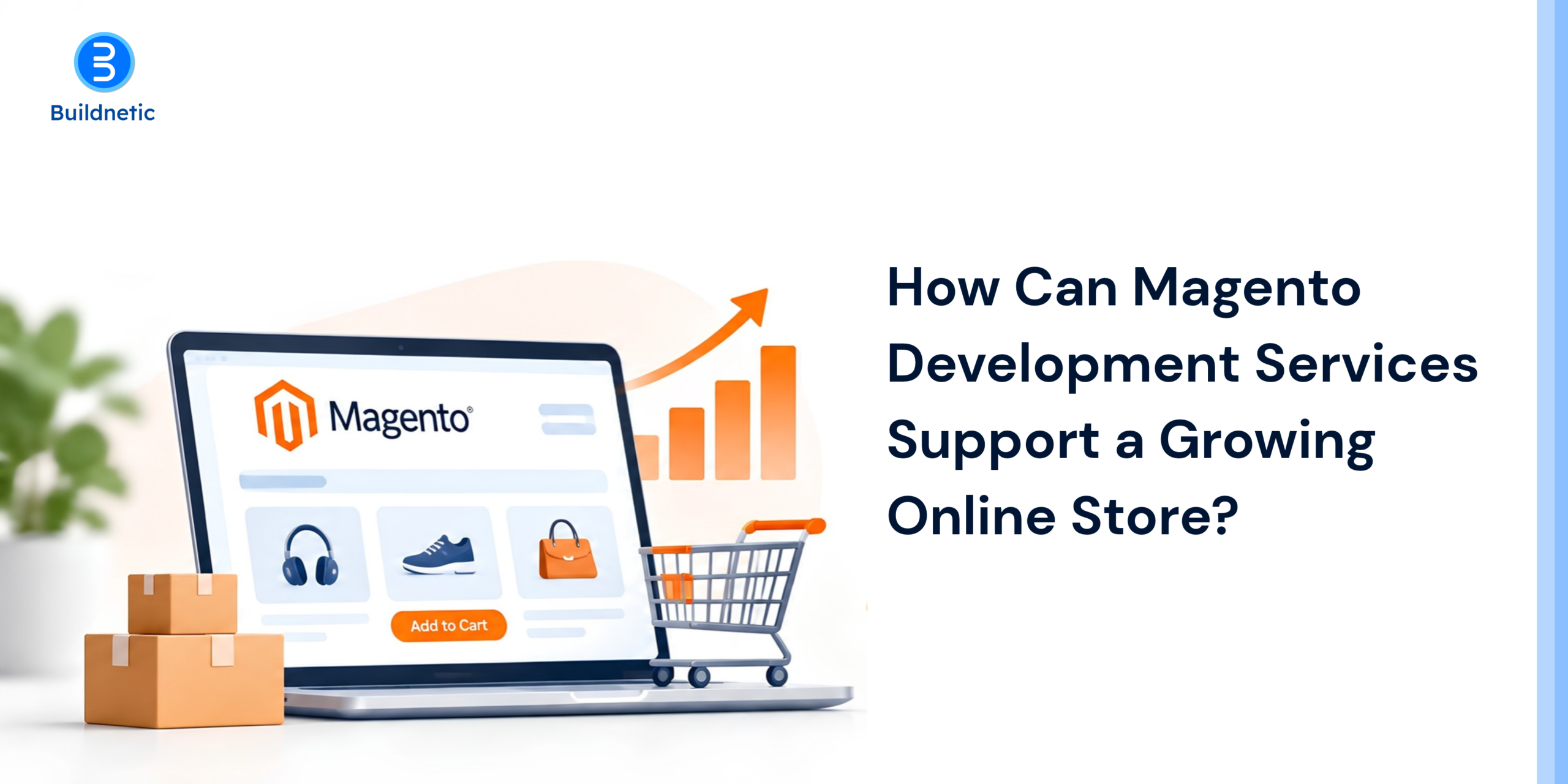
How Can Magento Development Services Support a Growing Online Store?
As your online store grows, your website needs to keep up. More visitors, more products and more orders all put extra pressure on your site. If it isn’t built to handle that, you’ll start seeing slow pages, stock errors and abandoned carts.
Magento is one of the most popular platforms for growing ecommerce businesses. But to get the most out of it, you need the right setup and support. That’s where Magento development services help. In this blog, we’ll explain how they keep your store fast, secure and ready to scale.
First, What Is Magento?
Magento is an ecommerce platform built for stores that want to grow. It’s now owned by Adobe and is also known as Adobe Commerce.
It can handle thousands of products, lots of visitors and even multiple stores. The catch? It works best when someone who really knows it sets it up and looks after it.
What Does a Magento Team Actually Do?
Think of them as the people who keep your store running smoothly behind the scenes. They usually help with:
- Setting up your store and making it look the way you want
- Adding new features and tools
- Moving your store over from Shopify, WooCommerce or an older platform
- Making your site faster and safer
- Fixing problems and keeping everything updated
Now let’s look at how this helps as your store grows.
Your Store Stays Fast, Even on Busy Days
Have you ever left a website because it took too long to load? Your customers do the same.
A Magento developer can make your pages load faster. They clean up messy code, remove things that slow your site down and set it up to handle more visitors.
Here’s an example. Say you’ve got a big Diwali or Black Friday sale coming up. Your developer can test the site with heavy traffic weeks before. If something breaks, it breaks during testing, not on sale day.
You Can Add More Products and Even New Stores
Adding 50 products is easy. Adding 5,000 is a different story. Magento handles big catalogues without much fuss.
It also lets you run more than one store from the same dashboard. Let’s say you’re a UK brand opening up in Dubai. You can set up a separate store with local prices and language. Both stores can still share the same products and stock.
You Get Features Made for Your Business
No two businesses work exactly the same way. Sometimes the standard features just aren’t enough.
The good news is that Magento can be customised. A developer can add things like:
- Special prices for wholesale or trade customers
- Subscription or repeat orders
- Product builders, so customers can design their own item
- Delivery rules based on location or parcel weight
Your Tools Start Talking to Each Other
When you’re small, copying orders into a spreadsheet is fine. But with hundreds of orders a day? That gets tiring fast.
Magento can connect to your accounting software, warehouse system and courier partners. Once it’s set up, orders and stock update on their own. Less copying, fewer mistakes, more free time.
Your Store Stays Safe
Your store handles payments and customer details, so keeping it secure really matters. Adobe releases security updates for Magento regularly.
A good developer tests each update on a copy of your site first. Once everything looks fine, they add it to your live store. That way, your site stays protected without anything breaking.
More People Find You, and More of Them Order
A well-built store is easier for Google to understand. Small fixes, like faster pages and cleaner product pages, can help you show up higher in search.
A simple checkout helps too. Fewer form fields and trusted payment options mean fewer people give up before paying. Pair this with our ecommerce SEO services, and your store has a much better chance to grow.
How Do You Pick the Right Magento Partner?
Not every agency knows Magento well. Before you choose one, ask a few simple questions:
- Do they have Adobe-certified developers?
- Have they worked with stores like yours?
- Do they test changes before going live?
- Will they support you after launch?
At Digiconnekt, we like to think of ourselves as your long-term team, not a one-time fix.
Let Your Store Grow Without the Headaches
Growth should feel exciting, not stressful. Magento development services help your store stay fast, safe and ready for whatever comes next. The best time to prepare is before things start slowing down.
Feeling like your store is getting stretched? Digiconnekt can take a look and tell you what to fix first. Check out our website development services and website maintenance support to get started.
FAQs
- Is Magento a good fit for small businesses?
Yes, it can be. Magento Open Source is free to use, so it’s a good starting point. It then grows with you as your store gets bigger. Just keep hosting and development costs in mind. - What’s the difference between Magento and Adobe Commerce?
Magento Open Source is the free version. Adobe Commerce is the paid version. It comes with extra tools for wholesale selling, marketing, hosting and direct support from Adobe. - How long does it take to build a Magento store?
It really depends on what you need. A simple store can be ready in a few weeks. A store with lots of custom features might take a few months. - Will I lose my Google rankings if I switch to Magento?
Not if it’s done properly. Your developer will point your old page links to the new ones. They’ll also keep your page titles and descriptions safe and test everything before launch. - How often does a Magento store need updates?
Security updates should be added soon after Adobe releases them. Bigger upgrades usually happen a few times a year, once they’ve been tested properly.
When Should a Business Choose Custom Ecommerce Website Development?
Most online stores start on platforms like Shopify or WooCommerce. They’re easy to set up, affordable and quick to launch. For many businesses, that’s all they’ll ever need. But some stores reach a point where things stop running smoothly. If that sounds familiar, custom ecommerce website development might be worth a closer look.
So how do you know it’s time? Let’s talk it through.
First, What Does “Custom” Mean?
Here’s a simple way to think about it. A template store is like a rented flat. It’s ready to use, but you can’t change much. A custom store is like building your own house. You decide where everything goes.
With custom ecommerce website development, your store is made for your business. It works the way you work, not the other way around.
6 Signs You Might Need a Custom Store
1. Your Business Doesn’t Quite Fit
Template stores are great for simple selling. Add a product, set a price, take the payment. Done. But what if you sell in bulk to other companies? Or offer monthly subscriptions? Or have many sellers on one site? Plugins can help for a while. Sooner or later, those quick fixes start to break.
2. Your Site Feels Slow
Every plugin adds a little extra weight to your site. One or two won’t hurt. Twenty or thirty can make pages drag, especially on phones. And nobody enjoys waiting for a page to load. Google also considers page speed when ranking sites. A custom store only includes what you need, so it stays fast.
3. Your Tools Don’t Work Together
As you grow, you’ll likely use other software too. Maybe one tool for stock, one for customers and one for accounting. Ideally, they all share information automatically. With a template store, that doesn’t always happen. A custom build can connect everything properly. That means less manual entry and fewer mistakes.
4. The Costs Keep Adding Up
Template stores come with ongoing costs. Think monthly plans, hosting, paid themes and app subscriptions. Some platforms also take a small cut of each sale. When you’re small, it hardly matters. As your orders grow, so does the bill. A custom store costs more upfront but can save money for busy stores over time.
5. Your Store Looks Like Everyone Else’s
Many businesses use the same handful of templates. So plenty of stores end up looking alike. If you want your brand to stand out, that’s a problem. Maybe you want customers to design their own product. Or see suggestions based on what they like. Features like these are much easier with a custom store.
6. You Want to Sell in Other Countries
Selling abroad is exciting. It also brings new things to sort out. Think about different currencies, payment methods, local taxes and languages. Some platforms handle the basics well enough. Once things get complicated, a custom setup usually does a much better job.
When You Should Stick With a Template
Custom isn’t for everyone, and that’s completely fine. If you’re just starting out, a template store is the smarter pick. It’s faster and cheaper to launch. Also, a custom store needs regular care. That includes updates, security checks and a good team behind it. Without that support, even a great site can fall behind.
Here’s a quick comparison:
| Template Store | Custom Store | |
| Time to launch | Days or weeks | A few months |
| Cost to start | Low | Higher |
| Flexibility | Limited | Built your way |
| Ongoing costs | Rise as you grow | Mostly hosting and upkeep |
| Best for | New or small stores | Growing or complex stores |
Quick Check: Is It Time?
If you answer “yes” to two or more of these, a custom store is worth exploring.
- Are you relying on workarounds for everyday tasks?
- Has your site become noticeably slower?
- Do you enter the same data in more than one system?
- Are your platform costs climbing every year?
- Are you planning to sell in new countries?
- Is your template stopping you from adding features you need?
Curious what a custom store could look like for you? Take a look at [Brand Name]’s ecommerce website development services. You may also find our guide on picking the right ecommerce platform useful.
The Bottom Line
Going custom isn’t just a tech upgrade. It’s about giving your business room to grow. The best time to switch is when your current store starts getting in your way. Look at your costs, your daily tasks and your plans for the next few years. If your template causes more headaches than it solves, custom ecommerce website development could be the answer. Not sure yet? The Buildnetic team is happy to talk it through with you.
Frequently Asked Questions
- What’s the difference between a custom store and a template store?
A template store uses a ready-made design with set features. A custom store is built around your business. You decide how it looks and works. - How long does it take to build a custom store?
It depends on what you need. Most take a few months. Stores with lots of features or integrations may take longer. - Will a custom store help my Google rankings?
It can help. You get more control over speed and how your pages are set up. You’ll still need good content and ongoing SEO work. - Can I move from Shopify or WooCommerce later?
Yes, and many businesses do. With careful planning, you can keep your products, customer data and rankings safe. - Do I need a technical team to manage a custom store?
Not in-house. Most businesses work with a development partner for updates and security. Day-to-day tasks like adding products can still be simple.
When Do Businesses Need Cybersecurity Consulting Services?
If you run a business, chances are cybersecurity is somewhere on your list. Maybe not near the top, and that’s okay. Most owners we speak to feel exactly that way. There’s payroll to sort, clients to keep happy and a team to look after. Security tends to sit quietly in the corner until something small makes you look at it again.
Sometimes that’s a login alert from a country nobody has visited. Other times, a new client asks how you protect their data, and you’re not quite sure what to say. It’s usually around then that people start reading about cybersecurity consulting services. And one question almost always comes up first. Do we actually need this?
Honestly, it depends. But there are a few moments where outside help makes a real difference, and they’re good to know about.
When the business has grown a little faster than expected
Say you started with eight people and a shared drive. A couple of years later, you’re at forty. There are new laptops, new apps, maybe a second office and a few people working from home. Everything still works, which is great. But the way you handle passwords, access and backups probably hasn’t changed much since day one.
That’s really common, and nobody has done anything wrong. It just builds up slowly. It might be shared logins, old accounts for people who’ve left, or backups nobody has tested in a while. A consultant can sit with you, look at what’s in place and point out the gaps that genuinely matter. Quite often, the fixes are smaller than people expect.
When your data has moved to the cloud
A lot of growing businesses move to AWS, Microsoft Azure or Google Cloud along the way. These platforms are very secure, but there’s a small catch. They follow a shared responsibility model. The provider takes care of the infrastructure, and you take care of your settings and who has access.
In our experience, cloud problems are rarely dramatic. It’s usually a folder that was shared a bit too widely, or too many people with admin rights. A simple review against guidelines like the CIS Benchmarks can catch these early. It’s quiet work, but it gives you real peace of mind.
When someone else starts asking questions
Sometimes the push comes from outside. Bigger clients often send a security questionnaire before signing a contract. They might mention ISO 27001 or SOC 2, or ask what you’d do if something went wrong. If it’s the first one you’ve seen, it can feel like a lot.
Rules around data are also getting tighter. In Singapore, the Personal Data Protection Act (PDPA) sets out how businesses should collect, use and protect personal data. It also requires organisations to report significant data breaches. If you have customers in Europe, GDPR applies too. An experienced consultant can turn all of this into a clear, manageable checklist. Those client conversations then feel much easier to handle.
When you’ve had a close call, or your IT team is stretched
Near misses are another common nudge. An email account gets accessed briefly, or someone catches a fake invoice just in time. It’s natural to feel relieved and carry on. Still, it helps to find out how it happened, because that gap is usually still open. Someone experienced can help you trace it back calmly. They can also set up a simple plan, so everyone knows what to do next time.
Your IT team’s workload matters here too. Most in-house teams are busy keeping the lights on, so deeper security work keeps slipping. That’s no reflection on them. A short consulting project gives them expert backup without the cost of a full-time hire.
So, what’s the next step?
You don’t have to wait for something to go wrong before asking for advice. If any of this sounds familiar, a basic risk assessment is an easy, low-pressure place to start. It shows you where things stand and what needs attention first. The right cybersecurity consulting services should leave you feeling calmer and more in control.
Many businesses pair that with ongoing support, so things stay in good shape afterwards. At Buildnetic, we offer both, through our managed IT support services and 24/7 IT support for businesses. If you’d like to chat it through, the Buildnetic team would be glad to help.
FAQs
What do cybersecurity consultants actually do?
They start by looking at how your business currently handles data, access and devices. Then they help you understand the risks and decide what to fix first. Many also help with policies, compliance and staff training.
How often should we check our security?
Once a year is a good habit for most businesses. A fresh look also makes sense after big changes, like a cloud move or a new office.
We’re a small business. Is this really for us?
It often is. Smaller teams rarely have a security person in-house, so a bit of expert guidance goes a long way. Even a short project can make a noticeable difference.
How long does a typical project take?
A basic assessment usually takes a few weeks. If compliance or penetration testing is involved, it may take a little longer.
What’s the difference between a vulnerability assessment and a penetration test?
A vulnerability assessment finds known weak spots and lists them for you. A penetration test goes one step further. It safely mimics a real attack to see how far someone could get.
How Can Enterprises Protect Their Business From Growing Cybersecurity Risks?
Most businesses already use antivirus software. But hackers still find a way in. Often, it’s through small gaps that nobody noticed. The good news is that these gaps are easy to fix. Here are seven simple steps that help, and how cybersecurity services for enterprises can support you.
Why Is the Risk Growing?
Business data is now kept in many places. People work from home. Files are saved online. Other companies connect to your systems too. Each of these can become a door for hackers.
When hackers steal business data, it costs a lot. IBM’s 2025 report says the average cost is about $4.44 million. Companies also took around eight months to find and stop the problem.
1. Know What You Have
First, make a list. Write down your computers, software and online accounts. Note where your important files are kept. Also add any outside companies that can use your systems.
This list helps you spot old accounts and tools you no longer use. Hackers often go after these first.
2. Make Logins Safer
Many hackers get in using stolen passwords. Two-step login stops most of them. It asks for a second check, like a code, after the password.
Codes from a login app are safer than codes sent by SMS. Also, let each person open only the files they need for work. When someone leaves, close their account the same day.
3. Update Your Software Quickly
Hackers look for old software with known problems. Updates fix these problems. So, install important updates within a few days. You can also set updates to install on their own.
4. Check the Companies You Work With
Some outside companies may connect to your systems. If they’re not safe, you’re not safe either. Before giving them access, ask how they protect data. Give them only the access they really need.
5. Keep Watch All the Time
Hackers often attack at night or on weekends. So, someone should watch your systems 24/7. This way, anything strange is caught early. For example, a login from another country can be stopped quickly.
IBM found that companies using smart automatic tools saved about $1.9 million per attack. Most businesses get this help from a security partner.
6. Teach Your Team
Hackers often send fake emails to trick people. These emails are getting harder to spot. Short training every three months helps your team stay alert.
You can also send practice fake emails. This shows who needs a little more help. And make it easy for staff to report anything that looks wrong.
7. Back Up Your Files and Have a Plan
Use the 3-2-1 rule for backups. Keep three copies of important files. Save them in two different places. Keep one copy offline. Check your backups often to make sure they work.
Also, write a short plan for bad days. It should say who to call and what to do first. In Singapore, the PDPC looks after personal data protection. If customer data is leaked and it’s serious, you must tell them within three days. Add this to your plan.
How to Pick a Security Partner
If you want outside help, ask these questions:
- Do they watch your systems 24/7?
- How fast do they act when there’s a problem?
- Do they know the rules for your industry?
- Will they send you simple, regular reports?
At Buildnetic, our managed IT and security services take care of watching, updates, backups and help during attacks. We work alongside your own IT team.
Final Word
Staying safe online is about good habits, not just one tool. Know what you have, protect logins, update quickly, back up files and keep watch. The right cybersecurity services for enterprises make this much easier. Want to find your weak spots? Talk to our team.
Frequently Asked Questions
What do cybersecurity services for enterprises include?
They include 24/7 watching, quick help during attacks, updates, backups, staff training and help with industry rules.
Is two-step login enough?
It stops most attacks. Codes from a login app are safer than SMS codes.
How often should we check our backups?
At least once every three months. This makes sure they work when you need them.
Do we need our own security team?
Not always. Many businesses keep a small IT team and get a partner for 24/7 help.
What should we do first after an attack?
Disconnect the affected computers from the internet. Call your security partner. Then follow your plan and report the attack if needed.
Why Businesses Hire Dedicated Developers for Long-Term Software Projects
Hiring for a six-week build and a three-year product are not the same decision. A short project survives a team that rotates off at the end. A long-running product does not.
Every handover costs weeks. Someone new has to learn what the last person already knew. On a product you plan to keep improving, that cost repeats until it becomes the main thing slowing you down.
That is the problem the dedicated model exists to solve.
What Does a Dedicated Development Team Actually Mean?
You hire specific people who work only on your product. Same engineers, month after month. They report to your priorities, join your standups and use your tools.
It differs from project outsourcing in one important way. You are not buying a finished deliverable against a fixed scope. You are buying capacity and continuity, and you decide what that capacity works on.
Why Does Continuity Matter So Much?
Most of what makes a developer fast on your product is not in the code. It sits in their head.
Why a workaround exists in the payment flow. Which integration breaks when the vendor pushes an update. What your users complained about last year. None of that is written down anywhere, and none of it transfers in a handover document.
A team in its second year ships faster than a new one of equal skill. That gap is the real return on the dedicated model.
How Does It Compare With Fixed-Price Project Work?
Fixed price suits work with a clear finish line. A marketing site, a one-off integration, a defined migration. Everyone knows what done looks like.
Long-term products rarely work that way. Priorities shift as users tell you things. Under fixed price, every shift becomes a change request, a new quote and a delay. By your tenth change order, more time goes on paperwork than on building.
A dedicated team removes that friction. You reprioritise the next sprint without renegotiating anything.
Is It More Budget-Friendly Choice Than Hiring In-House?
Often, though, cost is not usually the main reason.
An in-house hire comes with recruitment fees, notice periods, equipment, benefits and the risk that they leave in nine months. Finding a senior engineer in a competitive market can take three to six months on its own.
With dedicated software developers for hire, you skip the hiring cycle and can scale the team up or down as the roadmap changes. The trade-off is that they sit outside your company culture, which takes deliberate effort to bridge.
What Should You Check Before You Commit?
Four things matter more than the hourly rate.
Ask who exactly you are getting, by name, and whether they work on anything else. Ask what happens if someone leaves, and how much notice you get. Ask who owns the code and where the repository lives, which should be an account in your name.
Finally, ask about the minimum commitment. Most arrangements run on three or six-month cycles, and a provider pushing for twelve months upfront is worth questioning.
When Does the Dedicated Model Not Fit?
It is not right for everything, and a good provider will say so.
If your scope is genuinely fixed and small, fixed price is simpler and usually cheaper. If you have no one internally who can set priorities, a dedicated team will sit idle waiting for direction. The model needs someone on your side who owns the roadmap.
It also needs real work to do. A team booked for 40 hours a week with 10 hours of decisions behind it wastes money.
Making the Decision
The question is not whether dedicated developers are better. It is whether your product has a finish line.
If it does, hire for the project. If your software is something you will keep improving for years, the cost of starting over with a new team every few months is the thing to avoid.
Thinking it through? Talk to the Buildnetic team about your roadmap. We will tell you honestly if a fixed-scope project would serve you better. If your plans are still taking shape, our guide on questions to ask before hiring developers covers that ground first.
FAQs
What is the minimum commitment for a dedicated development team?
Most providers work in three or six-month cycles, with 30 to 60 days’ notice to change the team size. Shorter terms exist but usually cost more per hour. Be cautious about twelve-month lock-ins before you have worked together.
How is a dedicated team different from staff augmentation?
They overlap heavily, and many providers use the terms interchangeably. Staff augmentation usually means individual people joining your existing team. A dedicated team more often means a self-contained group with its own lead. Ask which one a provider actually means.
Who manages a dedicated development team day to day?
You set the priorities, and the provider handles employment, reviews and cover. Larger arrangements usually include a project manager or team lead on their side. Someone internal still needs to own the roadmap and make decisions.
Can we scale a dedicated team up or down?
Yes, and that flexibility is one of the main reasons to choose it. Adding people usually takes a few weeks for recruitment and onboarding. Reducing the team normally requires notice, so check the terms before you sign.
Do we own the code written by a dedicated team?
You should, but only if the contract says so. Check that it transfers full ownership of the source code and design files. The repository should sit in an account registered to your business from day one, not at the end of the project.
-
How Can Magento Development Services Support a Growing Online Store?
-
When Should a Business Choose Custom Ecommerce Website Development?
-
How Can Businesses Choose the Right Ecommerce Development Agency?
-
How Can Businesses Protect Customer and Company Data From Security Threats?
-
When Do Businesses Need Cybersecurity Consulting Services?
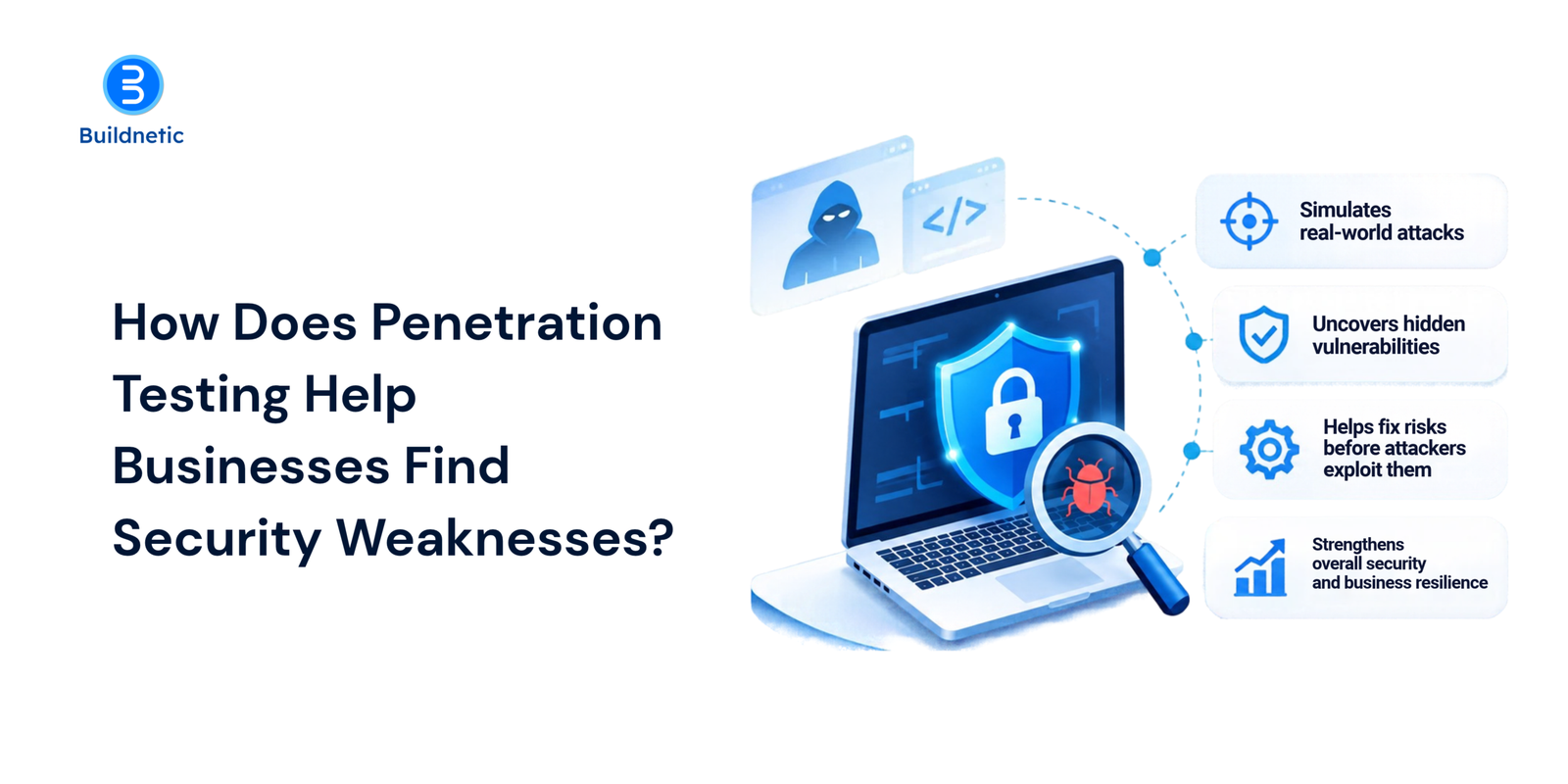
How Does Penetration Testing Help Businesses Find Security Weaknesses?
Most business owners we speak to feel fairly confident about their security. There’s a firewall, the antivirus is up to date, and staff know to use strong passwords. But small gaps have a way of creeping in over time, usually without anyone noticing.
Maybe a website plugin missed an update last spring. Or an old staff account was never switched off. None of this feels urgent on a busy Monday morning. Yet these are often the first things an attacker goes looking for.
Finding them early is the whole idea behind penetration testing. A good penetration testing company will try to get into your systems the way an outsider might. The difference is that they do it with your permission, and they tell you everything they find.
So, what happens during a test?
It starts with a conversation. You and the testers agree on what they’ll look at, whether that’s your website, office network, cloud apps or email. You also agree on timing, so your day-to-day work isn’t affected.
People sometimes ask how this differs from a vulnerability scan. A scan is a piece of software that runs through your systems and flags anything that looks risky. It’s useful, but it can’t tell you how serious a problem is. A penetration tester goes and checks. If a weakness could actually be used to get in, they’ll show you how.
Looking at your business from the outside in
Most testers begin with what anyone on the internet could see. That means your main website, any older sites, login pages and the services linked to them. It’s surprisingly common to find a test page from years ago that’s still online.
After that, they start trying things out, carefully and within the agreed limits. A contact form might be checked to see if it gives away more than it should. An admin login might be tested to see whether a password alone is enough to get in.
What we find most interesting is how small issues can add up. A minor flaw on its own might not worry anyone. Put it next to a reused password, though, and it could open a much bigger door. Automated tools rarely make that connection, but an experienced person often will.
Some businesses also ask for their team to be included. That might mean sending a harmless practice email that looks a bit like a scam. It just shows where a short refresher on spotting suspicious emails might help.
Issues that come up quite often
No two businesses are alike, but a few findings appear again and again. Out-of-date software is probably the most common. Logins that rely on a password alone come a close second. Every so often, we also see staff who can open files they don’t really need for their role.
Cloud sharing settings are worth a look too, as one left open can expose more than intended. Thankfully, most of these are quick fixes once they’ve been spotted.
The report, and what to do with it
Once testing is finished, you’ll get a written report. Each issue is given a risk level, from low to critical, so your team knows what to tackle first. Each comes with a plain explanation of how to put it right.
It’s worth asking whether a retest is included. After your fixes are in place, a short second check confirms nothing was missed.
Why work with a penetration testing company?
Your IT team knows your setup inside out, and that matters. But when you work with the same systems every day, some things naturally fade into the background. An outside penetration testing company sees everything with fresh eyes. Having worked with lots of different businesses, they also tend to know where problems like to hide.
There can be a compliance side as well. Many industry standards, especially those linked to card payments, expect regular testing.
Here at Buildnetic, we treat penetration testing as part of looking after your IT as a whole. If something turns up, our managed IT support team can help sort it out. You won’t be left working through the report alone.
A final thought
Security doesn’t need to feel overwhelming. A penetration test simply shows you where things stand today, so you can make sensible improvements at your own pace. Once a year, plus after any big change, is a comfortable rhythm for most businesses. If you’d like to talk it through, the Buildnetic team is happy to explain our penetration testing services.
FAQs
How often should we have a penetration test done?
Once a year suits most businesses. It’s also a good idea after a big change, like a new website going live or a move to the cloud.
Isn’t a vulnerability scan enough?
A scan is handy for regular check-ups, but it only points out what might be wrong. A penetration test goes a step further and shows whether someone could actually get in.
Will it get in the way of our daily work?
Usually, you won’t notice it’s happening. Timing is agreed with you beforehand, and anything more sensitive can be done outside office hours.
How long does it take?
That depends on how much is being tested. A single website might take a few days, while a bigger setup could take a couple of weeks.
What should we look for in a provider?
An experienced team that explains things simply is a good sign. It’s also worth asking to see a sample report and checking that a retest is included.

Maximizing Efficiency with IT Outsourcing Services: A Guide for Businesses
In today’s fast-evolving digital landscape, companies of all sizes are under pressure to stay competitive, scalable, and cost-effective. One proven strategy that continues to deliver value is IT outsourcing services, a flexible, powerful solution that enables businesses to maximize operational efficiency, minimize overheads, and focus on core competencies. Whether you’re a growing startup or an established enterprise, leveraging the right outsourcing partner can accelerate your business transformation.
What is IT Outsourcing and Why Does It Matter?
IT outsourcing refers to the practice of hiring external service providers to handle various technology functions that may include software development, network management, data storage, cybersecurity, or IT support. Instead of managing everything in-house, companies turn to experienced partners like Buildnetic to gain access to skilled talent, modern infrastructure, and scalable technology — without the heavy investment.
This approach is especially vital for businesses aiming to improve productivity while reducing operational complexities. By outsourcing IT functions, organizations can allocate internal resources more effectively, eliminate the hassle of managing an in-house tech team, and ensure around-the-clock support for mission-critical systems.
Benefits of IT Outsourcing Services for Businesses
1. Cost Optimization
Outsourcing IT operations reduces the need for capital investment in infrastructure, hiring, and training. Companies only pay for the services they use, often at a fraction of the cost of building an in-house team.
2. Access to Expert Talent
Buildnetic provides access to a global pool of skilled IT professionals who bring experience, innovation, and domain-specific knowledge. This reduces the learning curve and improves service quality from day one.
3. Scalability and Flexibility
As your business grows, so do your technology needs. IT outsourcing services allow you to scale operations up or down based on real-time requirements, without having to hire or fire employees internally.
4. Enhanced Focus on Core Business
Delegating IT functions to a trusted partner allows internal teams to stay focused on strategic initiatives, innovation, and customer experience, rather than dealing with daily technical issues.
5. 24/7 IT Support and Security
With IT support outsourcing, businesses gain round-the-clock monitoring, cybersecurity solutions, and real-time issue resolution. This minimizes downtime and enhances system reliability crucial in today’s always-on digital economy.
Choosing the Right IT Outsourcing Partner
Not all outsourcing providers offer the same level of service or transparency. It’s essential to choose a partner that understands your business goals and can align technology solutions accordingly. Buildnetic stands out with its client-centric approach, commitment to quality, and deep technical expertise.
Our tailored outsourcing models ensure that you retain control while benefiting from rapid deployment, proactive support, and cost-effective IT solutions. From initial consultation to post-deployment maintenance, Buildnetic provides end-to-end coverage that empowers your business to thrive in a tech-driven world.
Use Cases: How Businesses Benefit from Outsourcing
- Startups can quickly launch MVPs using outsourced development teams without investing in long-term hiring.
- SMEs benefit from on-demand support and infrastructure management without overstretching internal staff.
- Enterprises reduce IT overheads and improve time-to-market for digital products by collaborating with remote engineering teams.
Final Thoughts: IT Outsourcing as a Strategic Enabler
In a market where technology underpins every facet of business success, outsourcing is no longer just an operational tactic; it’s a strategic enabler. By partnering with Buildnetic for IT outsourcing services, companies gain more than just technical support; they gain a committed team, innovative thinking, and a roadmap to sustainable growth.
Whether you’re looking to streamline operations, innovate faster, or cut IT costs, IT support outsourcing with Buildnetic delivers the performance, flexibility, and expertise your business needs to stay ahead of the curve.

Is Your Tech Stack Killing Your Growth? Here’s What to Fix Now
In today’s fiercely competitive digital system, your tech stack can either be a catalyst for growth or a silent killer. Many businesses unknowingly hold themselves back with outdated or bloated technology stacks that slow down operations, increase costs, and limit scalability. If your company is experiencing stagnant growth despite investments in digital tools, it’s time to ask: Is your tech stack the culprit?
At Buildnetic, a leading IT Consulting Agency in the UK, we help businesses transform their technological infrastructure to unlock agility, efficiency, and long-term success. Here’s how to identify what’s wrong and what you need to fix now.
Signs Your Tech Stack Is Stalling Your Growth
- Integration Nightmares: Do your systems struggle to talk to each other? A fragmented tech stack often leads to data silos, manual workarounds, and inconsistent user experiences. This inefficiency directly impacts customer satisfaction and employee productivity.
- Outdated Legacy Systems: Old technologies may seem “good enough,” but they often lack compatibility with modern platforms and cloud-based solutions. Legacy systems slow down operations and hinder innovation.
- Poor Scalability: If your tools don’t grow with your business, they become liabilities. A rigid tech stack hinders expansion, complicates workflows, and necessitates excessive developer hours for maintenance.
- Rising Maintenance Costs: Maintaining an inefficient stack is expensive. Constant patches, version mismatches, and security updates drain your budget funds that could otherwise go toward innovation and growth.
What do You Need to Fix Now?
- Audit Your Entire Tech Stack: Start with a comprehensive audit. Understand what tools you’re using, where they overlap, and how well they integrate. Look at performance metrics, cost, and user satisfaction. At Buildnetic, we provide in-depth assessments tailored to your specific needs and industry challenges.
- Embrace Cloud-Native Solutions: If you’re still operating with on-premise software, it’s time to rethink. Cloud-native applications offer scalability, flexibility, and real-time collaboration, making your business more agile and cost-efficient.
- Prioritize API-First Tools: Systems that are designed to integrate from the ground up will save you countless hours and costs in the long run. An API-first approach ensures your tools communicate seamlessly, allowing for faster deployment and smoother operations.
- Adopt a Modular Architecture: Microservices and modular platforms help businesses innovate faster by isolating and improving individual components. This allows you to upgrade systems without disrupting your entire ecosystem.
- Invest in Automation and AI: Modern growth requires intelligent automation. From CRM to project management and customer service, automation minimizes manual tasks and boosts output. Buildnetic helps companies harness AI and machine learning to optimize efficiency and decision-making.
Why Partner with Buildnetic?
As an established IT Consulting Agency in the UK, Buildnetic brings unmatched expertise in technology stack optimization, digital transformation, and customized software development. We work closely with startups, SMBs, and enterprises to create lean, scalable, and future-proof systems.
Our hands-on consulting and implementation services help you eliminate the tech clutter, reduce operational friction, and improve your time-to-market. Whether you’re migrating to the cloud, integrating new APIs, or rebuilding your entire tech foundation, we deliver proven results.
Conclusion
In a digital-first world, your technology stack is more than just a support system; it’s the backbone of your business growth. If your current tools are holding you back, it’s time to take a hard look at what’s working and what’s not.
Don’t let outdated tech stall your progress. Partner with Buildnetic, the trusted IT Consulting Agency in the UK, and let us help you build a smarter, faster, and more scalable tech ecosystem through expert technology stack optimization.
-
How Can Magento Development Services Support a Growing Online Store?
-
When Should a Business Choose Custom Ecommerce Website Development?
-
How Can Businesses Choose the Right Ecommerce Development Agency?
-
How Can Businesses Protect Customer and Company Data From Security Threats?
-
When Do Businesses Need Cybersecurity Consulting Services?